Reconstructing Dignity: A Case Study in Applied Anatomy and Professional Leadership at St Andrews

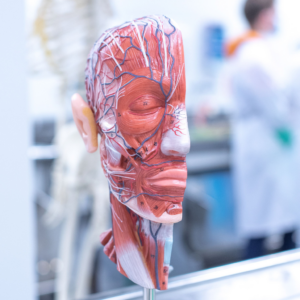
Medicine at the University of St Andrews is built on a clear understanding that anatomy, ethics and real-world impact are inseparable. One place where this comes into sharp focus is with post-mortem reconstruction, a specialist area of practice concerned with restoring the appearance of the face and head after traumatic death, so that individuals can be presented with dignity, supporting families to have the option of viewing.
Hosted by the and delivered as a joint venture with practitioner-educator Martin Jeffrey MBIE Dip Fd, the Post-Mortem Reconstruction Course is one of only three programmes of its kind worldwide. It represents a rare meeting point between academic anatomy, professional practice, and evidence-based approaches to care for the bereaved.
What is post‑mortem reconstruction, and why does it matter?
Post‑mortem reconstruction involves the structured restoration of cranial and facial appearance following traumatic injury. Drawing directly on detailed anatomical knowledge, it combines assessment, planning, and technical intervention to address damage caused by accidents, violence, or other catastrophic events.
While the work is highly skilled and technical, its purpose is fundamentally human. Research across medicine, psychiatry and trauma studies shows that, for many families, the opportunity to view the deceased can play an important role in understanding what has happened, beginning to process loss, and supporting healthier grieving. When that opportunity is not possible, distress and long‑term psychological impact can be greater.
For professionals working in this area – embalmers, anatomical pathology technicians, and related roles – post-mortem reconstruction is about anatomical responsibly and ethics, ensuring that technical decisions are guided not only by skill, but by care, consent and respect.
This is the context in which the St Andrews course has been developed: not as an isolated technical training, but as an applied extension of anatomical and medical knowledge with clear social impact.
An intensive, carefully governed learning environment
Delivered annually, the course aligns with the academic calendar, allowing delegates access to university accommodation and helping to reduce overall costs.
The programme runs at two levels:
- Level 1: 12 places
- Level 2: 4 places (available only to delegates who have completed Level 1)
Cohort sizes are deliberately small. This ensures close supervision, structured progression, and the ability to engage meaningfully with complex material.
Teaching takes place within the Anatomy Department’s facilities, under established ethical and governance frameworks. Delegates move from foundational demonstrations to structured practical learning, with a strong emphasis on anatomical assessment, planning, and decision‑making. The focus is not on outputs alone, but on understanding why particular approaches are taken and how anatomy informs every stage of the process.
Learning that extends beyond the course
The educational model extends beyond the course itself through the Scottish International Embalming and Post‑Mortem Reconstruction Conference, founded and led by Martin Jeffrey and hosted at St Andrews every two years.
What makes the conference distinctive is its deliberately multi‑industry approach. It brings together practitioners, academics and specialists from different sectors to explore post‑mortem reconstruction and care of the deceased from a broader, more integrated perspective.
Course delegates are offered the opportunity to take part immediately after their training, placing their learning within an international, cross‑disciplinary context.
Responding to a changing professional landscape
Originally developed for professional embalmers, the course is already evolving. Recent cohorts have included NHS Anatomical Pathology Technicians, reflecting its growing relevance within healthcare environments as well as independent practice.
Entry is intentionally selective. Delegates must be working in roles where the skills learned can be used regularly and responsibly. This ensures the integrity of the learning environment and recognises the level of responsibility inherent in this work.
Taking responsibility where it counts
The Post-Mortem Reconstruction Course focuses on applying anatomical knowledge carefully, ethically and with purpose in an area of healthcare that is rarely visible, but profoundly important.
It shows how the School of Medicine at St Andrews leads in nuanced, high-impact spaces, where research meets practice, and where scientific understanding is inseparable from human consequence. It is one example of how St Andrews continues to shape modern medicine not only through what it teaches, but through what it chooses to take responsibility for.
Find out more in this recent interview with Martin: https://www.youtube.com/watch?v=2RP9MgXwliU