
The Dream Team Project
Designing Better Sleep for Teens Through Stakeholder Collaboration
Nearly 40% of Scottish 14-year olds did not meet the NHS recommendation of 8-10 hours of sleep most nights (1), a finding which can have notable impacts on adolescent school performance (2), mental wellbeing (3), and weight (4). This project thus calls upon the expertise of key figures who influence adolescent sleep – caregivers and healthcare professionals – to deign feasible interventions to effectively improve teen sleep now and into adulthood.
Project Scope
During adolescence, the evolution of biological rhythms, accompanied by changing social factors and environmental factors can compound to negatively impact sleep quality and quantity.
During adolescence, changing sleep-wake cycles, or circadian rhythms, tend to contribute to later bedtimes and less sleep (5).
Social changes, such as increased autonomy over caffeine consumption and nighttime screen use, also may negatively impact sleep (6).
Environmental changes – like early school start-times, increasing homework, and extracurriculars – also often push bedtimes back, disturbing sleep (5).
Research has shown us that caregivers and healthcare providers are two of the biggest influences on adolescent sleep patterns.
Caregivers are pivotal in establishing nighttime routines, role-modelling sleep habits, and teaching about sleep behaviour.
Health professionals are key sources of insight and support for adolescents seeking information or help for sleep problems.
As such, these key stakeholders must be a fundamental part of shaping strategies to address adolescent sleep health challenges – contributing both their valuable insight and their practical ability to actually intervene in teen sleep behaviours.
Project Structure
This study brought together 8 local caregivers and 4 healthcare professionals to engage in a series of 3 focus groups.
1
The first meeting centred around the caregivers’ and healthcare professionals’ existing knowledge of adolescent sleep and the challenges they’ve experience in promoting healthy sleep.
2
The second meeting revolved around brainstorming strategies for improving adolescent sleep – particularly what format and content would most resonate with teens.
3
The third meeting culminated in healthcare professionals and caregivers collaborating to design an actual adolescent sleep intervention.
Outcomes
From the discussions with healthcare professionals and caregivers, some key themes emerged.
Key Themes From Caregivers:
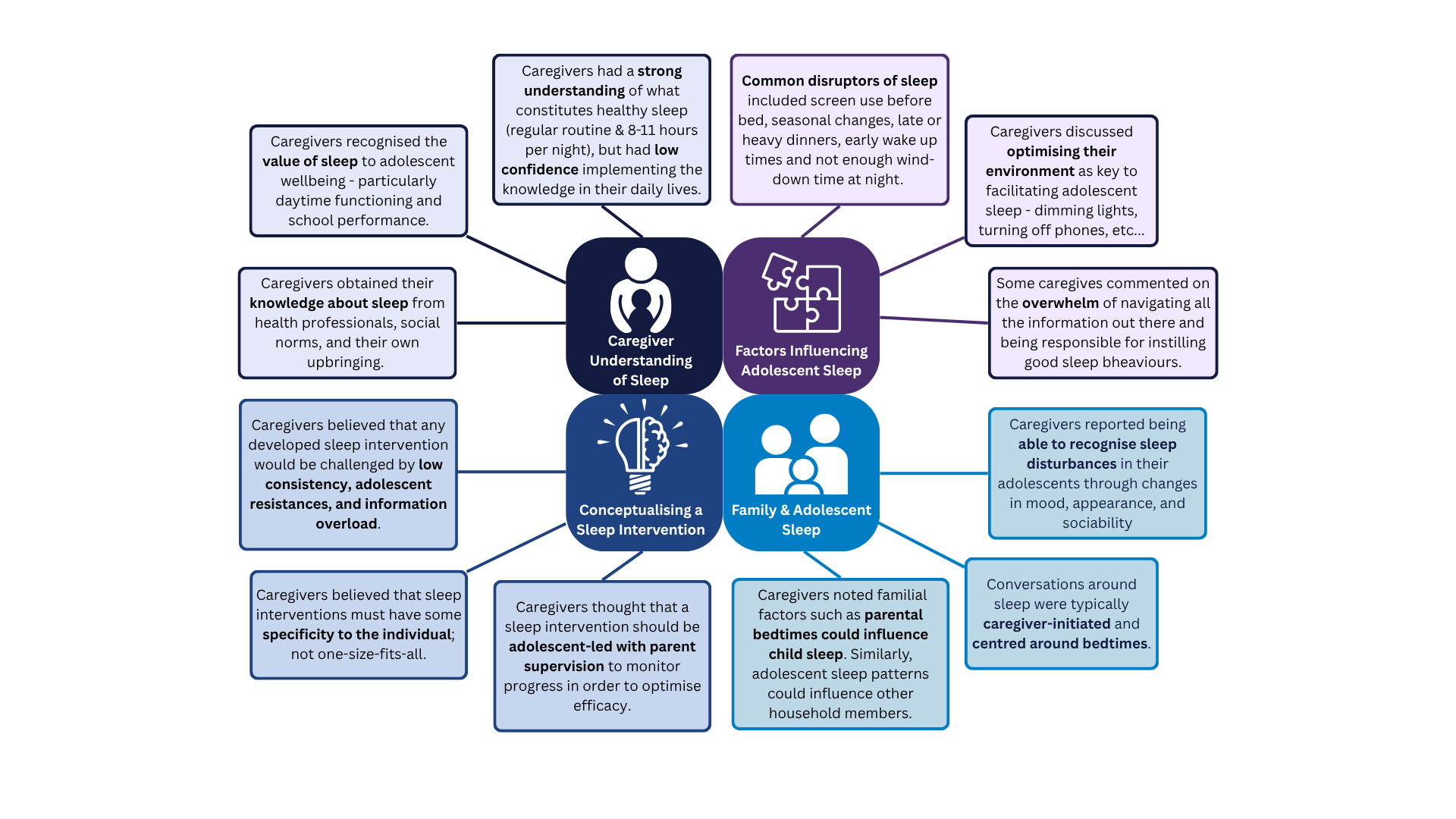
Key Themes From Healthcare Professionals:

Caregivers and healthcare professionals were also tasked with developing an idea for a sleep intervention to help improve adolescent sleep.
Find out the ideas the stakeholders came up with below!
Dummy
Your content goes here. Edit or remove this text inline or in the module Content settings. You can also style every aspect of this content in the module Design settings and even apply custom CSS to this text in the module Advanced settings.
Caregiver-Developed Sleep Intervention
Caregivers developed a two-part sleep intervention consisting of…
Part 1) A Sleep Health App
The caregivers proposed developing a sleep app that serves as both a sleep education tool and sleep tracker. Features would include:
- Educational content delivered through short-form videos made by popular influencers and fun elements, such as memes.
- Sleep tracking features – allowing users to track number of hours sleep, sleep quality, and daily moods.
- Parental accounts to monitor child sleep progress.
- Access to resources on sleep promoting techniques, such as guided meditations.
Part 2) In-Person Workshops
Accompanying the app, caregivers thought that 2 in-school workshops would help to reinforce learning and app usage.
- The first workshop could introduce adolescents to the basics of sleep health and familiarise them with the sleep app.
- The second could occur after a few months to allow peers to discuss sleep progress.
Healthcare Professional-Developed Sleep Intervention
Healthcare professionals also came up with an idea for a sleep app with 3 different elements:
1. Educational Content
The app would contain a couple weeks worth of short-form videos on sleep health developed by sleep researchers to teach adolescents about sleep. The content would vary based on adolescent age to ensure the teaching was pitched at the right level.
2. Resources to Improved Sleep
The app would include access to resources like breathing exercises, guided meditations, and white noise to help users fall asleep.
3. Sleep Tracking Features
The app would also serve as a sleep tracking tool, with users self reporting bedtimes and wake-up times. The app would send daily reminders to reinforce this habit of tracking and being mindful of sleep patterns.
Still Curious?
Contact the Authors for More Information
Currently, impact reports and publications for this project are under development. If you would like more information, please reach out to the authors:

Hayley Stone
Student Researcher
Contact at: [email protected]

Dr. Emma Gale
Research Fellow in Child and Adolescent Sleep Health & Sleep Research Lead
Contact at: [email protected]
Page Citations
- Scottish Government. Life at age 14: initial findings from the Growing Up in Scotland study. In: Directorate CaF, editor. 2022 Feb 15.
- Chaput JP, Gray CE, Poitras VJ, Carson V, Gruber R, Olds T, et al. Systematic review of the relationships between sleep duration and health indicators in school-aged children and youth. Appl Physiol Nutr Metab. 2016 Jan 13;41(6 Suppl 3):S266-82.
- Kostev K, Kaur N, Vetter C, Konrad M. Sleep disorders are associated with subsequent depression and anxiety disorders in children and adolescents in Germany-a retrospective cohort study. J Psychiatr Res. 2025 May 15;187:299-303.
- Gale EL, James Williams A, Cecil JE. The relationship between multiple sleep dimensions and obesity in adolescents: A systematic review. Sleep Med Rev. 2023 Nov 17;73:101875.
- Crowley SJ, Acebo C, Carskadon MA. Sleep, circadian rhythms, and delayed phase in adolescence. Sleep Med. 2007 Mar 26;8(6):602-12.
- Jakobsson M, Sundin K, Hogberg K, Josefsson K. “I Want to Sleep, but I Can’t”: Adolescents’ Lived Experience of Sleeping Difficulties. J Sch Nurs. 2020 Oct 16;38(5):449-58.
Funding
This programme was made possible through funding from the British Sleep Society.
