


Outputs

SLDN’s activities and interests have generated diverse outputs from press coverage and op-ed pieces in mainstream as sell as specialist media to academic publications in specialist journals. Some of these are highlighted below. See also the Resources page for an array of tools for teachers, parents and professionals.
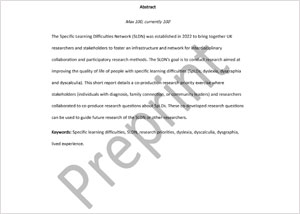
Co-produced research questions about dyslexia, dysgraphia, and dyscalculia: A collaboration between researchers and stakeholders facilitated by the UK Specific Learning Difficulties Network
June 2026
New preprint by researchers from SLDN available
The Specific Learning Difficulties Network (SLDN) was established in 2022 to bring together UK researchers and stakeholders to foster an infrastructure and network for interdisciplinary collaboration and participatory research methods. The SLDN’s goal is to conduct research aimed at improving the quality of life of people with specific learning difficulties (SpLDs; dyslexia, dysgraphia and dyscalculia). This short report details a co-production research priority exercise where stakeholders (individuals with diagnosis, family connection, or community leaders) and researchers collaborated to co-produce research questions about SpLDs. These co-developed research questions can be used to guide future research of the SLDN or other researchers.
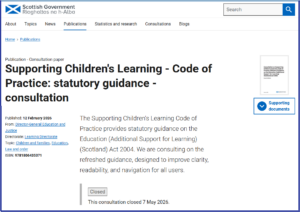
SLDN response to Scottish Government consultation on Supporting Children’s Learning – Code of Practice
April 2026
Researchers and practitioners from SLDN have submitted a joint response from the Network to the Scottish Government’s consultation on Children’s Learning – Code of Practice. You can read that response in full here.

Toward an Improved Understanding of Dyslexia: Reflections on a New Consensus Definition and Its Implications
February 2026
A group of researchers from around the SLDN created a response to the recent Delphi study that produced a new definition of dyslexia, and that response was published in ‘Dyslexia – Ain international journal of research and practice’.
Inconsistencies in the definition and diagnosis of dyslexia continue to impede research, assessment, and intervention. This paper, authored by members of the UK Specific Learning Difficulties Network, critically examines a recent effort to establish a consensus definition and guidance for assessment and intervention for dyslexia, which involved 58 experts from academia, practice and lived experience. The resulting framework offers a developmental, multifactorial and continuum-based perspective. It expands on prevailing definitions by highlighting the influence of multiple genetic, environmental and cognitive factors, as well as developmental changes in dyslexia profiles. However, unresolved issues remain, including ambiguity around prevalence and the role of general cognitive functioning, and a lack of clear guidance for educators. The definition also lacks clarity on assessment and intervention, especially in global contexts where teaching practice may be highly variable. Co-occurrence with language and mathematics difficulties is acknowledged but underexplored, limiting implications for practice. Whilst the Delphi method provides useful consensus, we also reflect on its limitations, including potential bias in the composition of the panel. Overall, the framework is a valuable step forward, but unresolved issues remain both from a research perspective and in terms of practical implementation.
You can find the full article here.

Shaping UK Research Priorities in the Area of Specific Learning Difficulties by Surveying People with Lived Experience
June 2025
New paper illuminates research priorities from lived experience perspective
A new study by SLDN researchers has been published in Neurodiversity. It illuminates the lived experiences of people with dyslexia and other specific learning difficulties (SpLDs), revealing – in fact; confirming – significant challenges in identification, support, and mental health outcomes. The UK-based survey of 145 adults and carers of children with SpLDs including dyslexia (119 participants), dyscalculia (14), and dysgraphia (12).
The findings underscore the high co-occurrence of SpLDs with each other and with other neurodevelopmental traits such as ADHD and autism. Notably, 43% of respondents reported mental health issues, primarily anxiety and depression, with higher rates among those with multiple SpLDs. This highlights clearly the need for holistic support targeting both learning and emotional wellbeing.
Despite increased awareness, at least for dyslexia, half the respondents found the diagnostic process as difficult or very difficult, with no significant improvement across generations (comparing adults reporting on their own experiences and adults reporting on their child/young person). Support following diagnosis was also inconsistent, particularly for dyscalculia and dysgraphia. Generally, the findings highlight systemic gaps in identification and provision, especially outside of dyslexia, which remains the most recognised SpLD. Unsurprisingly, therefore, when asked about research priorities, identification and effective support were respondents’ top concerns. Those with dyscalculia also emphasized the need for greater public awareness and easier access to identification.
Survey respondents overwhelmingly supported framing SpLDs within the neurodiversity paradigm, and preferred terms like “learning difference” over “disorder.” Views on genetic testing for SpLD predisposition were mixed, however, and reflected both awareness and caution.
The research team advocates co-produced research involving people with lived experience to increase future studies’ relevance and impact. These findings will guide the next phase of SLDN’s work, including focus groups and priority-setting partnerships, to shape a more inclusive and evidence-informed research agenda.
You can find the full article here.
In the Media
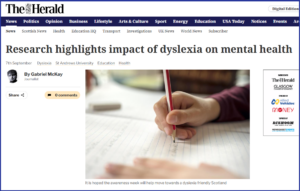
Long read in The Herald on research linking dyslexia and mental health challenges
5 Sept 2026
A new analysis by a Scottish university has laid bare how common mental health challenges are for people with dyslexia…[read more may encounter paywall]

TES piece on SLDN’s research translation event
16 April 2025
6 ways to improve interventions for specific learning difficulties
There is plenty of research around SLD – such as dyslexia, dyscalculia and dysgraphia – but teachers and schools need to be involved in developing new approaches.
There is no shortage of research, tools, products and services purporting to offer insight and solutions for teachers and learners dealing with specific learning difficulties. A motivated corps of experts, developers, entrepreneurs and others create ways to combat the difficulties and downstream disadvantages that come with SLD such as dyslexia, dyscalculia and dysgraphia, or combinations of these. How do they know what teachers and students need? How do they know where the gaps are, what makes existing interventions work and what might have changed since their previous tests or trials? And how do specialists and class teachers know what’s new “out there” or coming down the tracks? Or how to engage with the development of more up-to-date or effective edtech?
These questions were posed by a UK-wide event in March, held at the University of St Andrews and organised by the Specific Learning Difficulties Network, which brought together interests from across the SLD sector to examine how to improve the pathway from research and development to real-world results. Researchers, edtech entrepreneurs, specialist teachers and assessors, education authority officials and third-sector bodies assembled to hear case-study presentations from around the UK, and from a dozen edtech providers.
So what were some of the key messages about what needs to happen now?
- More pace
All parts of the sector want the pace of research and related interventions to increase.
- More participation
Academic researchers and commercial developers alike have trouble getting schools, teachers and local authorities to take part in research and user testing. Barriers such as workload, red tape or difficulties with “officialdom” prevent otherwise willing and interested schools and teachers from signing up to involvements that may bring benefits. SLD are also typically considered niche, so may have less profile than developments for “the mainstream”.
- Permission
Local authorities should empower and enable individual schools and teaching groups to work with research and new developments. Delegates’ view was that real-world testing of new products and the adoption of useful ones should be a priority.
Resistance to change has hampered progress, too. Normalising link-ups between researchers and schools could increase participation in research, promote more dynamism around new developments and expedite progress of effective improvements.
- Co-design
Making it easier for schools, teachers and learners to work with researchers would tackle the issue of the “user perspective” not being given enough attention in the design or delivery of new research and interventions. Researchers know the value of co-designing projects, and this also needs to be understood by officials and decision makers, to help them enable such collaboration.
- Quality standards
Some sort of official quality-assurance system should be created for interventions, so that users can be sure of the scientific or pedagogical basis for new tools and tech – a version of the National Institute for Health and Care Excellence (Nice) but for education.
- Collective problem-solving
High on delegates’ wish list was more cross-sectoral interaction, so that all parties involved in a problem get around a table and focus on the minutiae of what each role can do. Practitioners need to speak to policy people as a matter of course and to third-sector bodies that also are involved as sponsors or funders of new work. Having an open channel of communication with politicians who are motivated, well-informed and committed to progress rather than political point-scoring was also identified – this will be crucial to real improvement, in schools and beyond, where it matters most.
Gillian Stirton is research coordinator with the Specific Learning Difficulties Network, based at the University of St Andrews
[This is a transcript of an article published in TES on 16 April 2025 and is subject to TES copyright.]

Why schools need to look beyond dyslexia
17 May 2023
It’s important to continue to raise awareness about dyslexia, but lesser-known literacy and language difficulties also deserve our attention, says Maggie Snowling.
[click image to read article]
DSA and genetics: discovering the latest scientific results
13 February 2023
Dr Silvia Paracchini discusses the genetics of dyslexia with the Italian Dyslexia Association in a live streamed event.
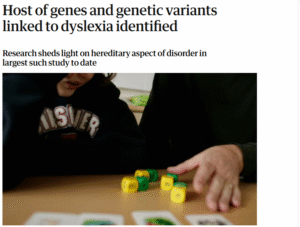
Host of genes and genetic variants linked to dyslexia identified
20 October 2022
Research sheds light on hereditary aspect of disorder in largest such study to date. A host of genetic variants associated with dyslexia have been identified by researchers, shedding light on the hereditary aspect of the disorder.
[click image to read article]

Genomic research that can help explain personality traits and behaviour raises ethical questions
12 April 2022
Increasingly cheap and powerful technology means genomic data can be generated at scale, allowing the investigation of the genetic basis for all sorts of traits, including our behaviour and personality.
[click image to read article]
The Genetics of Dyslexia | Specific Learning Disorders, Scotland
13 Jan 2022
In this episode of Dyslexia News Darren chats to Dr Silvia Paracchini & Dr Michelle Luciano following on from their project ‘Specific Learning Disorders in Scotland’ receiving a £10,000 funding boost from the Royal Society of Edinburgh. We delve into the genetics behind dyslexia and the different ways that the learning difference effects people including the impact interests and personality traits have on dyslexia.
Publications
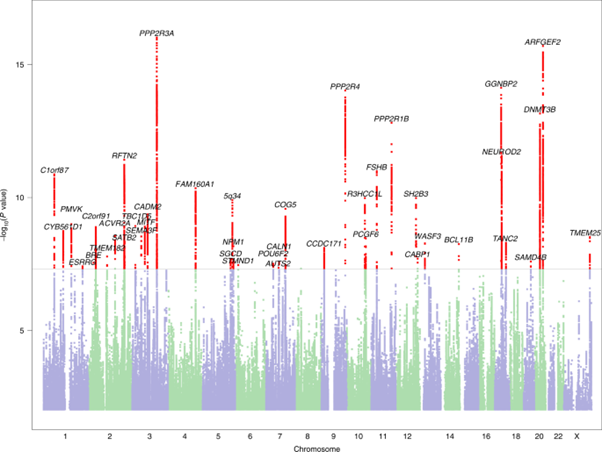
Discovery of 42 genome-wide significant loci associated with dyslexia
Reading and writing are crucial life skills but roughly one in ten children are affected by dyslexia, which can persist into adulthood. Family studies of dyslexia suggest heritability up to 70%, yet few convincing genetic markers have been found.
[click image to read article]

Nature v Nurture
The question of whether it is genes or environment that largely shapes human behaviour has been debated for centuries. During the second half of the 20th century, there were two camps of scientists – each believing that nature or nurture, respectively, was exclusively at play.
[click image to read article]