
Research
Dr Hammond’s research follows four main strands:
Development of Novel Diagnostics
Antimicrobial Resistance (AMR) is a growing threat this is already costing the global economy billions of pounds per year, notwithstanding the personal and clinical impacts it has on patients and their families. A seminal report by Professor Jim O’Neill stated explicitly that one of the few methods to combat this threat is with the application of rapid, sensitive diagnostics that can determine bacterial susceptibility in a few minutes. Our research is focussed upon this task and has met with great success. In 2016 we won a Longitude Discovery Award. In 2017 we were runner up for the Times Higher Education Awards and in 2018 we both won the Scottish Life Sciences Award for New Innovation and spun out a company to commercialise our technology. This company has attracted >$35m(USD) in funding and employs over 25 people in Scotland.
We are in the process of developing new technology and welcome interest from potential new students and colleagues.
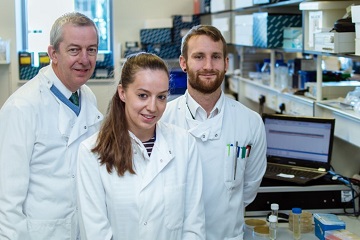
The team behind SLIC’s development
Mycobacterial resistance and disease relapse
Mycobacteria, and specifically Mycobacterium tuberculosis (MTB), cause disease and death on a global scale but disproportionately affect low- and middle-income countries (LMICs). One of the difficulties of treating MTB is its propensity to evade the immune system and the intensive drug regimen prescribed to suffering patients. This is believed to be in part due to the bacteria’s ability to enter a ‘dormant’ phenotype, leading to ‘latent’ disease. When in this phenotype MTB will appear to have been treated successfully but will frequently relapse after a number of months or years.
Previous work undertaken in Dr Hammond’s lab has shown that it is possible to force mycobacteria into a dormant phenotype using a variety of stress conditions. When in this phenotype mycobacteria express lipid inclusion vesicles, termed lipid bodies. These lipid rich cells have been shown to be up to 40X more resistant to the antibiotics used to treat patients.
What Dr Hammond and colleagues are attempting to do now is to discover the mechanisms by which mycobacteria become lipid rich, if this can be prevented and how to treat patients that carry a large proportion of these resistant bacteria as part of their infection.
Combination therapy to tackle AMR
Another method of dealing with AMR has been outlined as using combination therapy. This is using more than one antibiotic at once to treat a resistant infection, clearing that infection, and reducing the emergence of new resistance phenotypes.It is understood that increasing the number of antibiotics given to a patient can have several benefits:
From the patient’s point of view the chief benefit is that the concentration of each component of the therapy can be reduced significantly. This reduces the chance of a toxic reaction in the patient while still clearing a highly dangerous infection.
From the scientific and clinical point of view it is known that combination therapies are more difficult for bacteria to evolve resistances to as there are more active agents acting upon each bacterium and the population as a whole.
The third valuable aspect is synergy. Combining effective agents can lead to an effect that is greater than the sum of the parts. This is synergistic antimicrobial action and is the current focus of Dr Hammond and colleagues. Dr Hammond’s lab are using a high throughput method to hunt for synergistic combinations of antimicrobials to combat currently relevant resistant pathogens (the ESKAPE group) and benefit patient outcomes.
Covid-19
A recent Innovate UK grant has added a new workstream to Dr Hammond’s lab, in the wake of the Covid-19 pandemic UVC light has been seen as a possible method of dampening the effect of viral spread. The effects of UVC light on human skin commensal bacteria is unknown. Dr Hammond and colleagues at the university of Dundee are working to understand what effects, if any, this radiation will have on the bacteria that live on our skin.