Scotland is experiencing an ongoing public health crisis of increasing drug and alcohol related deaths. The Scottish drug-related death rate is four times that of the UK as a whole and is more than twenty times the rate in Europe, making it comparable to the opioid crisis in the USA. Similarly, Scotland alcohol death rates exceed those in the rest of the UK, and are among the highest in Western Europe.

Source: National Records of Scotland (2024) Alcohol-Specific Deaths in Scotland
National Records of Scotland (2024) Drug-Related Deaths in Scotland.
Despite recent policy responses and efforts at the service and community levels, drug and alcohol-related harm remains a major public health challenge. The human and social costs of substance-related ill health and death continue to rise, highlighting the need for transformative innovation across health and care systems.
Innovation in addiction care is increasingly dependent on the use of digital technologies and novel therapeutic approaches to enhance prevention, early detection, treatment, and recovery. Digital health interventions offer promising opportunities to transform how we address addiction by targeting persistent barriers and improving outcomes.
Digital interventions and innovation in addiction care have the potential to drive transformation in response to the following core challenges.
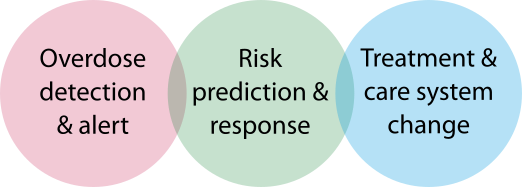
Challenge 1: Detecting and responding to early onset of non-fatal and fatal overdose
This challenge focusses on detecting and responding to early acute onset of non-fatal and fatal overdose through, for example:
- Use of discrete digital technology for easy use by the substance using population in clinical and non-clinical settings
- Simple alert / responder pathways that created effective responses to potentially fatal overdose events
- Enhanced ability to remotely self-monitor by people who use drugs
- Improved equity of access, detection and response in this vulnerable population through connected and safe digitalised platforms
- Live intelligent data gathering processes.
Challenge 2: Identifying and responding to rising risk
There is a need to improve and accelerate detection and surveillance resulting in timely interventions to reduce drug and alcohol morbidities and mortalities. This involves data collection at public health, service and individual levels by using innovative data driven technologies, synthesis and predictive modelling. This challenge can be met through:
- Improved public and individual health surveillance
- Live intelligence to identify early emerging and changing drug trends
- Early detection of morbidities secondary to drug and/or alcohol use and groups most at risk through better data collection, curation and analytics
- Targeted provision of accessible and acceptable information for people who use drugs and alcohol, and their families
- More connected and useful clinical electronic information systems that are acceptable to clinicians, decision-makers and researchers, and reflect the multidisciplinary and multi-agency nature of care provision for people who use alcohol and other drugs.
Challenge 3: Improving drug and alcohol services using innovative system changes to enhance or improve the delivery of care and interventions
Addressing this challenge requires efforts at several levels:
Macro level (policy)
- Synthesise multiple evidence sources and assessment methods to generate coherent evidence from multiple, complex systems
- Develop an understanding of formal and informal organisational cultures and local contexts that underpin need and current / potential responses
- Actively engage with stakeholders at all levels, including civil society, policy and decision-makers, service providers, and people who use drugs/alcohol and those affected by substance use
- Develop ways of modifying interventions which balances standardisation with local needs and initiatives
- Develop approaches that are informed by and aligned with, contextual trends and priorities.
Meso level (organisational)
- Data-driven models that describe the system’s properties (systems diagrams and models, computer-based modelling to illuminate the dynamics of the system)
- Multimethod and multidisciplinary research and improvement models and techniques
- Develop mechanisms and provide continuous feedback to the relevant stakeholders
- Focus on key leverage points that will produce optimal system improvements.
Micro (frontline work)
- Approach solutions from a systems perspective: connections between different problems rather than focussing on a single solution.
- Learn from real-time behaviours, practices, and language that are representative of organisational culture (e.g. risk perceptions)
- Influence opportunities for micro and granular adaptations that can be strengthened to generate Incremental (common) and transformational (rare) change
- Understand the meanings and social connections which underpin practice (e.g. through normalisation process theory).
We have developed a programme of activities to understand and address each challenge.
| Challenge | Response |
|---|---|
| Non-fatal and fatal overdose | Interventions to detect onset of overdose, triggering alert and timely response. |
| Patterns of risk amongst people who use alcohol and other drugs | Data science-driven exploration of factors associated with development of problematic substance use and of harmful outcomes (morbidity and mortality). |
| Improving services for people who use drugs and alcohol | Application of implementation science and systems thinking to identify and address system dynamics that influence the uptake, adaptation, and sustainability of evidence-based practice. |